Margaret Salt Mclellan's 'Sardines and Silk'
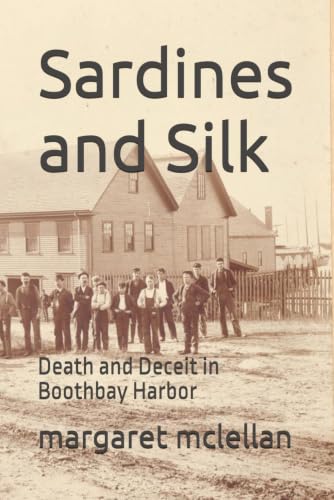
Why are girls in the packing line at the sardine cannery in Boothbay Harbor being murdered? The year is 1910 and this industry is thriving. So what’s going on? In addition to their deaths, bundles of silk and seal skins are being shipped out in crates labeled “Maine sardines”? And, are all the seals really seals … or are there also selkies among them (more about them later)? Other intriguing characters in this tale include the Madam running the brothel on Sea Street where some of the prostitutes are meeting the same fate as the sardine factory women; a mysterious stranger walks the streets; and a beautiful woman, whose name is an alias, also works at the factory and can be heard singing in the cove by the footbridge by night.
Welcome to some of the storylines in Margaret Salt Mclellan’s fourth novel, “Sardines and Silk.” The sardine cannery storyline was inspired by her father, Myron Mclellan. Margaret and her siblings were eating sardines with him while he talked about the sardine canneries in Boothbay Harbor in the 1900s. During that time many families became very successful. Chief among the canneries was the Luther Maddocks Packing Company. At some point during this sharing of local history, Margaret said the words "sardines" and "silk" just popped into her head. Who says coming up with a novel title is hard?
In fact, in a Google search I found, a 1901 edition of the Boothbay Register (naturally!) included this bit about the Maddocks Co.: “(It) was the biggest establishment of its kind in Maine, and, perhaps, the country. Maddocks built many processing plants for a variety of fish in Boothbay Harbor circa late 1800s – early 1900s.”
She noted there were the six canneries in Boothbay Harbor, seven if you count the one she created for the story, but much smaller than any of those owned by Maddox. “People were making money like crazy back in 1910. They bragged about this one girl, who was such a fast packer, she could make $7 a day. That's equivalent to like 300 bucks a day now.”
“And, I don't think a lot of people know, for instance, why Factory Cove was called Factory Cove,” Margaret said. “It’s because that’s where the first sardine factory was. The book also gives a lot of information about how the factory girls lived. The whistle blew at four in the morning. They'd walk through town, across the footbridge, and then sat in the cold packing sardines. I’ve also included how fast they had to be ... It just opens up something that I haven’t read any fictitious stuff about.”
But, said Margaret, "Sardines and Silk" isn’t all about historical facts, although she did devote the final chapter to historic data about these sardine factories in Boothbay Harbor and Maine. The novel is merely based around it. Two historical research sites she used were Boothbay Region Historical Society and Maine Coast Sardine History Museum.
Another layer of intrigue involves the illegal silk trade that was happening during the same timeframe as the novel that would lead to opium wars. “Silk was coming from China and was bootlegged to Europe and different places. Well, the Chinese didn't want money for it; they wanted opium, so it kind of started the opium epidemic in China,” she said.
Remember the selkies I mentioned earlier on? You were probably asking yourself, 'What’s a 'selkie?’ For most people, they're mysterious, mythological creatures part of Celtic and Norse folklore, particularly, it seems, in the Northern Isles of Scotland. Male and female selkies can transform into humans by shedding their seal skin. Oh, and the best part: They are known to be absolutely gorgeous with magnetic personalities, and magical. Ahhh, be still my heart!
Margaret’s been fascinated with selkies forever, really. And the author's favorite selkie guy is her Caspian who keeps coming back, and with more relatives. It isn't unusual for an author to become fond of a character or two. Think Agatha Christie who wrote 12 novels and 20 short stories featuring Miss Marple, and Sir Arthur Conan Doyle had Sherlock Holmes to name a couple. Then there was Tolkien's "The Hobbit" and the trilogy. Too many to list.
“I love him (Caspian). So I decided to write another storyline for the book about the fishermen killing the young seals and stealing their pelts. These were going to Boston and New York, along with silk. People wanted sealskin coats from Boothbay, Thistle Island (Margaret’s imagined island from book three) and Monhegan Island because the skins had this mystical quality about them.”
And so Caspian and the selkies of the seal colony seek revenge against those fishermen and the cannery guys involved, too.
Margaret did a great deal of research in Scottish and Irish folklore to find out what popular names for selkies were – like Caspian. His son is Merle, who is half human due to Caspian having mated with one. And there is Aceland, a selkie taken captive by a fisherman on Monhegan and who is trying to escape.
Margaret is not the only writer in the family. Grandmother Mclellan wrote short stories for Reader’s Digest – and sold them. When she died, Margaret found numerous boxes filled with her grandmother's stories inside. "I thought, I should write something because I have a vivid imagination,” shared Margaret. “I used to write little short stories in high school and so forth. But after my eldest son, Sam was born, he’s 42 now, we were living in Virginia and I thought I’ll start writing about the moonshine industry down here and build a story around it. And that's when I started ‘Salt House Ranch' ... and I finally just finished it." The book was published this June.
I asked Margaret what jazzes her so much about the whole writing process. “I think it’s finding all of these people, and all of these circumstances, inside my own head," she said. "You know, exploring my own imagination and recalling things that I had heard about or read about from years and years ago. And when I get into the flow of writing, I just like developing this whole scenario … when I don’t have anything to write, that’s when I start missing my characters.”
Right now her books are available on Amazon. I just bought “Sardines and Silk” from there. Hopefully, though, all four of Margaret Salt Mclellan’s books will soon be available locally as well! Now I’d better finish my current book, “The Blackbird Oracle,” by Deborah Harkness, before Margaret’s arrives. Happy reading, all!