New spin for old propeller
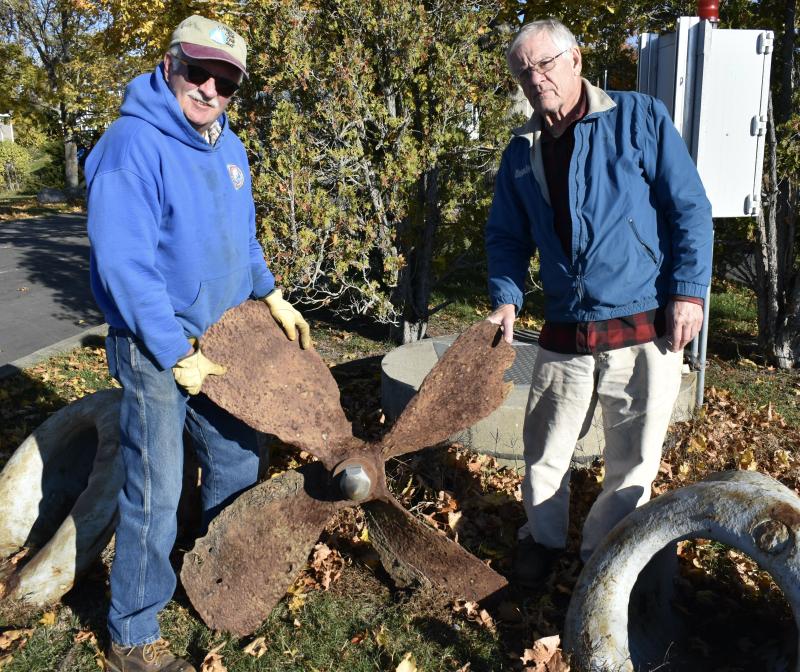 Steve Erskine, left, and Steve Christiansen pose with the Winter Harbor propeller. PHIL DI VECE/Wiscasset Newspaper
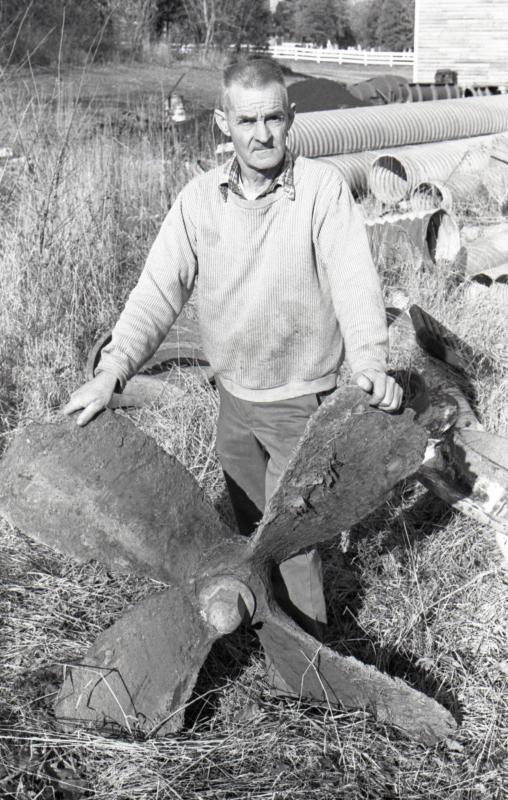 The late Maurice Caton of Wiscasset posed for a picture with the propeller. The photo was taken by the author in the early 1980s. Cast iron propellers were often used rather than brass ones because they were often broken and cheaper to replace.
Steve Erskine, left, and Steve Christiansen pose with the Winter Harbor propeller. PHIL DI VECE/Wiscasset Newspaper
The late Maurice Caton of Wiscasset posed for a picture with the propeller. The photo was taken by the author in the early 1980s. Cast iron propellers were often used rather than brass ones because they were often broken and cheaper to replace.
They say everything comes around again and so it is with an old propeller that for some of us has a bit of fond nostalgia attached to it. As recently reported in this newspaper, Wiscasseter Steve Erskine has offered to take a turn at restoring the propeller that once pushed the steamboat Winter Harbor up and down the Sheepscot River from Wiscasset to Boothbay Harbor. Left to the mercy of the elements for many years, Mother Nature has slowly eaten away at the propeller’s four cast iron blades. But maybe this time something will finally be done to preserve this maritime relic from the steam age. I’ve known Steve a long time; if anyone can see this project through he can.
You could say Steve is one of those Mainers who has saltwater in his blood. He’s a 40-year member of Wiscasset Yacht Club, and has owned many boats over the years including a Friendship sloop he continues to sail. He recently retired after working 42 years at Bath Iron Works. Much of his career was spent in welding/engineering, although in recent years his responsibilities at the Bath shipyard included serving as a tugboat captain. After they've been launched the tugs guide the newly built Naval ships into the Kennebec River. Steve’s also one of the volunteer captains of the Virginia. That’s the floating classroom and living museum built by volunteers of Maine’s First Ship, a non-profit group also based in Bath where the vessel is berthed.
Steve has a personal interest in preserving the propeller. “My granddad, Roy B. Rowe, was the last captain of the Winter Harbor, so me seeing the propeller preserved is a bit personal. It also serves as a link to our town’s past. I think it would be wonderful to have it properly preserved and put on display at the waterfront.” Steve hopes to involve Bath Iron Works in the preservation project. “They’ve got the means and expertise to do a permanent restoration of the propeller. They’d have ideas too, how best to mount it after the work is finished.”
The story of the Winter Harbor began over a hundred years ago in the early 1900s. In those times coastal Maine was still greatly dependent on the water because there were very few paved roads. The fastest way to travel from Wiscasset to the communities on the Boothbay peninsula was by water. One of the boats that routinely made the trip was the Winter Harbor, a small steamboat nicknamed, “Old Reliable” for its reputation of always being on time.
About 35 years ago Jim Sutter, Wiscasset’s harbor master, suggested I write a newspaper story about the Winter Harbor. Jim put me in touch with Maurice Caton who worked as a laborer for the town’s highway department. (Both Mr. Sutter and Mr. Caton have long since passed away.) In hindsight, I think Jim was hoping something might be done about saving the boat’s propeller that had been stashed behind the town garage for safekeeping. I’ll get to how that happened in a minute. When I interviewed him, Maurice told me he’d been aboard the Winter Harbor dozens of times when he was a boy.
“My Uncle Mark used to work as a deckhand on her,” he said, adding the Winter Harbor used to make three trips a day back and forth from Wiscasset to Boothbay Harbor. Along with mail, the boat carried freight, passengers and the latest news.
For many years the Winter Harbor provided a good living for its owner and skipper Captain Frank Rowe, but like all steam-driven vessels, her fate was sealed with the arrival of the early automobiles and better roads. In 1927, the Winter Harbor’s ownership suffered a financial blow when they lost the mail contract. Harder times were to come during the years of the Great Depression. Unable to adapt to the changing economy the Winter Harbor was soon left abandoned at the Wiscasset waterfront. One day the junkmen arrived and stripped her of her brass, copper and anything else of value. The vandals then had their way, climbing aboard and wreaking havoc. After that she mysteriously sank tied at the pier.
Maurice Caton thought the boat went down in the spring of 1933. He remembered it was March, a bitterly cold day, windy, with cakes of ice along the shoreline. “One day I went to school and on the way home I saw she had gone down,” he said. For years after she sank, Maurice said you could clearly see the boat’s wheelhouse poking out of the water at low tide. Over time only her skeletal wood frame and boiler were visible under the water.
The Winter Harbor was pretty much forgotten until 1978, when one morning a team of divers showed up at the waterfront to explore what remained of the wreck, a diving club as Jim Sutter recalled. Whether it was a training exercise, or just something to do, the divers found and cut off the boat’s four-blade iron propeller. “Hacksawed right through the 4-inch shaft,” Jim told me, after which he said he hoisted it ashore using Wiscasset Yacht Club’s mooring puller. The divers apparently had no interest in keeping the propeller, which sat on the yacht club lawn a while before being hauled off to the town’s highway garage on Hodge Street. It sat behind the garage alongside a pile of old storm drains and other discarded junk until Maurice Caton unearthed the rusting relic for me to photograph for my newspaper story.
After that the propeller underwent its first restoration. Layers of loose rust were removed and a rust inhibitor applied. The propeller was then coated with several layers of paint, silver Rust-Oleum. The talk then was to put it on display at the waterfront near the flag pole with an informational plaque telling its story. After the restoration the propeller was taken to the waterfront, stowed away in the building there and soon forgotten about. In the early 2000s a portion of the Winter Harbor’s rusted round boiler was still visible underwater at low tide. It’s gone now, pulled out and deposited at the town’s landfill when work was done on the pier.
There was renewed interest in saving the propeller in 2011. Rick Lang, a former Wiscasset code enforcement officer, told me Frank Rowe, the owner and skipper of the Winter Harbor, had been his great-grandfather on his mother’s side. He said after Frank Rowe passed away, his sons Clarke and Roy took over ownership of the Winter Harbor and piloted the boat.
Lang said the front cover of The Rudder Magazine, dated March 1940, featured a picture of the sunken Winter Harbor. The pilothouse and bow are shown sticking up out of the water just as Maurice Caton described it. As to her sinking, Rick surmised once the boat’s boilers went cold there was no way to keep the water out of the bilges. He said no attempt was made to raise her because times were hard and money scarce. “Because she was a coal-burner, there was no value to her other than scrap,” he said.
According to Lang, the Winter Harbor was initially built to provide passenger and freight service between the villages of Bar Harbor and Winter Harbor, her namesake. After proving too small for her owners, she was put up for sale. In 1906 Captain Frank Rowe of Boothbay came to be in possession of her. After he passed away in 1925, Captain Roy B. Rowe took over the day-to-day operation of the steamboat, assisted by his brother Clarke Rowe. All of the Rowes lived at or near Boothbay Harbor. Lang told me the Winter Harbor’s schedule coincided with the arrival of the eastbound train of Maine Central Railroad’s Rockland branch. The Winter Harbor continued its Boothbay-Wiscasset run after losing the mail contract, but not for long; the boat’s last run was in 1932.
Along with the Winter Harbor’s propeller Steve hopes BIW might restore several of the old iron pieces salvaged from the old Wiscasset schooners, Hesper and Luther Little. These include the iron bollards, hawse pipes and capstan all of which can be found at the waterfront.
Phil Di Vece earned a B.A. in journalism studies from Colorado State University and an M.A. in journalism at the University of South Florida. He is the author of three Wiscasset books and is a frequent news contributor to the Boothbay Register/Wiscasset Newspaper. He resides in Wiscasset and be contacted at news@wiscassetnewspaper.com