The Sparrow of Inuit Nunangat
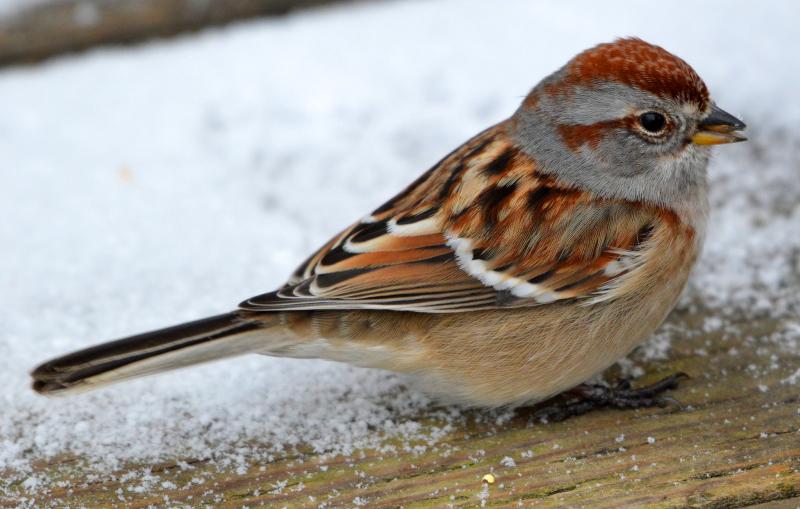 The black and yellow bill of the American tree sparrow is not its only identifying characteristic, but it is one of its most distinctive. Photo by Jocelyn Anderson, courtesy of WIkimedia Commons
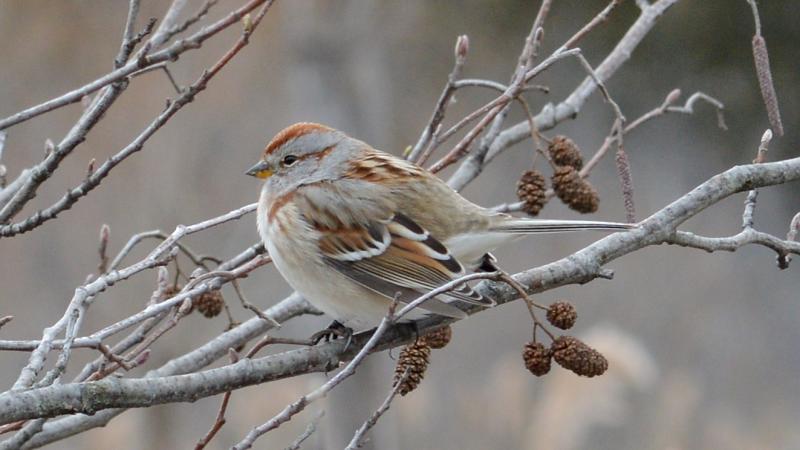 The majority of American tree sparrows spend the summers in the Arctic of the Inuit Nunangat of Canada but come south to southern Canada and the U.S. for the winter. Photo by Ryan Hodnett, courtesy of Wikimedia Commons
The black and yellow bill of the American tree sparrow is not its only identifying characteristic, but it is one of its most distinctive. Photo by Jocelyn Anderson, courtesy of WIkimedia Commons
The majority of American tree sparrows spend the summers in the Arctic of the Inuit Nunangat of Canada but come south to southern Canada and the U.S. for the winter. Photo by Ryan Hodnett, courtesy of Wikimedia Commons
In our post-Halloween and post-time-change Sunday afternoon lag, we went .looking for birds on the lakeshore where shorebirds and some ducks had been hanging out a few weeks ago when the water level was low and muddy lakebed was exposed. This crisp fall brilliant blue-sky day, the lake was full again, which meant no shorebirds or ducks in sight.
Then from the thick alder bushes near the roadside, a high tinkling call and some movement! Scanning with the binoculars, the head and breast of a perky sparrow came into view. Even without seeing its rufous crown, the black spot on its unmarked breast, and the white wingbars, we knew what it was—the only sparrow we could think of in which the upper part of the bill is black and the lower, bright yellow: American tree sparrow.
American tree sparrows might better have been named something like Arctic bush sparrows. About sixty-percent of their entire breeding range is in the Arctic biome, and even the remaining forty-percent that is in the Boreal Forest biome is along the scrubby transition to more open tundra in places like the Seal River Watershed of northern Manitoba.
Most of the breeding range of the American tree sparrow is specifically in the Arctic region of Canada known as Inuit Nunangat, the Inuit homeland, spread over the exotic-sounding regions of Nunatsiavut, Nunavik, Kitikmeot, Kivalliq, and Inuvialuit Nunangat. Yes, these cute little winter birds of our backyards may well have spent their summers among caribou, polar bears, Arctic foxes, narwhal, belugas, and walrus.
American tree sparrows leave their northern breeding range in the fall and migrate south to the very southern fringe of Canada and the northern two-thirds of the U.S.
Because American tree sparrows nest in such remote parts of the world, not a huge amount of research has been done on them. This was especially true back in the 1930s when a trailblazing woman named A. Marguerite Heydweiller was getting her doctorate at Cornell University and decided to work on them. We would love to know more details about this, but what we do know is that she spent two summers in Churchill, Manitoba, in the early 1930s in order to study them.
Marguerite finished her dissertation and graduated with a Ph.D. from Cornell in 1936. She continued studying American tree sparrows over her lifetime in between raising a family with fellow ornithologist Frederick Baumgartner, much of that time in Oklahoma. You’ll find her name as A. Marguerite Baumgartner in most of her publications and accomplishments. She passed away in 2004 at the age of 95.
Marguerite would have been saddened to know that American tree sparrows have undergone a more than 50% decline over the last fifty years based, on data on the wintering range from the Audubon Christmas Bird Count.
Maine is among the states that have shown some of the steepest long-term decreases in their numbers. Essentially, nothing is known about why the species is declining, and there remains much to learn about its biology and population status.
We were interested to discover that some researchers have been radio tagging American tree sparrows on the wintering grounds, making use of MOTUS wildlife tracking stations that automatically pick up the signals from the tags. One of these stations is in operation at Bates College and, interestingly, one February a few years ago, it picked up the signal of an American tree sparrow tagged in Ohio about three weeks earlier. Perhaps the bird was starting its journey northward with a stop in Maine before heading up into Canada.
Clearly, we need a modern-day Marguerite Baumgartner to start unraveling even more of the mysteries of the American tree sparrow.
Jeffrey V. Wells, Ph.D., is a Fellow of the Cornell Lab of Ornithology and Vice President of Boreal Conservation for National Audubon. Dr. Wells is one of the nation's leading bird experts and conservation biologists. He is a coauthor of the seminal “Birds of Maine” book and author of the “Birder’s Conservation Handbook.” His grandfather, the late John Chase, was a columnist for the Boothbay Register for many years. Allison Childs Wells, formerly of the Cornell Lab of Ornithology, is a senior director at the Natural Resources Council of Maine, a nonprofit membership organization working statewide to protect the nature of Maine. Both are widely published natural history writers and are the authors of the popular books, “Maine’s Favorite Birds” (Down East Books) and “Birds of Aruba, Bonaire, and Curaçao: A Site and Field Guide,” (Cornell University Press).