When Opportunity Strikes
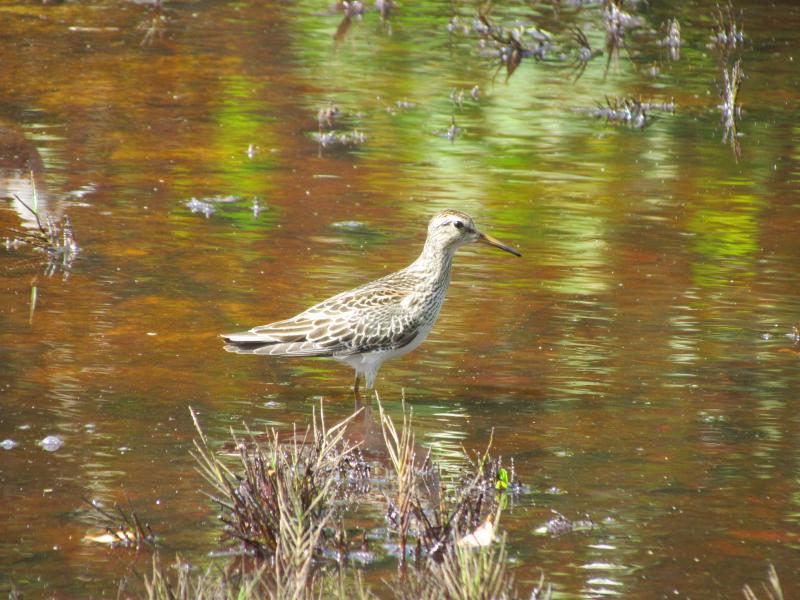 With their yellow legs and rusty brown upperparts, pectoral sandpipers look a bit like a larger version of the tiny least sandpiper. They breed in the Arctic but in migration favor shallow, grassy pools and muddy lake shorelines. Courtesy of Jeff Wells.
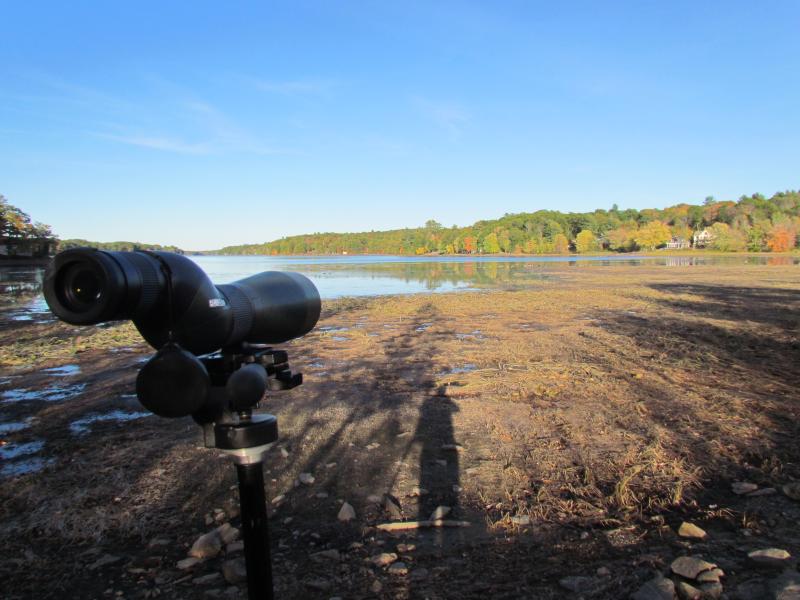 The drawdown on Pleasant Pond recently created muddy habitat that is great for migrating shorebirds. Courtesy of Jeff Wells
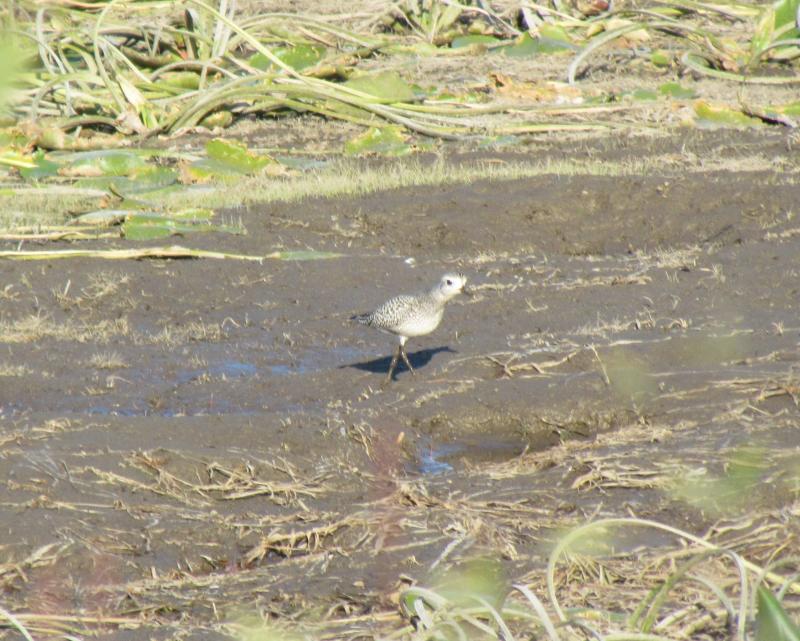 This juvenile black-bellied plover that hatched and spent the summer in the Arctic found the muddy shores of Pleasant Pond here in Maine during its southward migration in October. Courtesy of Jeff Wells.
With their yellow legs and rusty brown upperparts, pectoral sandpipers look a bit like a larger version of the tiny least sandpiper. They breed in the Arctic but in migration favor shallow, grassy pools and muddy lake shorelines. Courtesy of Jeff Wells.
The drawdown on Pleasant Pond recently created muddy habitat that is great for migrating shorebirds. Courtesy of Jeff Wells
This juvenile black-bellied plover that hatched and spent the summer in the Arctic found the muddy shores of Pleasant Pond here in Maine during its southward migration in October. Courtesy of Jeff Wells.
Envision birds migrating, let’s say hundreds or even a thousand feet overhead (some birds fly even higher). To us, they’d look like specks in the sky, if we could see them at all. When it’s time for them to rest and find food, they must decide where to descend to Earth. They need to make sure it’s a place that has the kind of habitat for which they are equipped. Ducks, for example, don’t want to drop down into a dry, rocky field or dense forest; they need a body of water, perhaps a lake or coastal bay. A warbler or a thrush would prefer a forest or scrubby edge where it can find insects or berries as well as protection from predators.
What is amazing is that the places that offer good habitat for migrating birds can often change from year to year. Sometimes, the places stay the same, but the kind of birds looking for those spots are not. Birds in their first autumn after hatching almost always are traveling without parental guidance and so can never know about a good location to stop ahead of time.
So we always find it incredible when a new habitat is created and somehow birds find it. A temporary drawdown of Pleasant Pond, between Richmond and Litchfield, this month has created some modest expanses of muddy shoreline that look a bit like a coastal mudflat at low tide. When we realized the lake level was down a few weeks ago, we decided to check out Throughfare Road, a road that cuts across from one side of the lake to the other and allows access for boat launching (when the lake level is higher) and for birding at any time.
We were thrilled to discover that the flat muddy expanse had somehow been discovered by the same birds that spent the summer in open, treeless expanses of the Arctic. This included a black-bellied plover—mind-bogglingly far from the closest nesting area on the southwestern side of Baffin Island in Nunavut. We could tell from its plumage that it was a young bird hatched just this summer. There were no others of its kind with it. This bird, only a few months old, had flown at least 1,400 miles south and found this little patch of habitat to stop, rest, and feed. This habitat had not existed a few weeks previous.
About a week later, we spotted eight pectoral sandpipers—medium-sized, rusty brown-backed sandpipers with yellow legs. There are one of the species birders sometimes affectionately call the “grasspipers” because they are often found at grassy wet spots, often at inland locations. Their closest breeding grounds were also about 1,400 miles away but on Southampton Island at the north end of Hudson Bay. And these were young birds, too. They could never have been here before because this was their first southward migration and again, the habitat had not existed here until a few weeks before. Yet as they migrated south, they had spied the muddy shores and dropped down to take advantage of the opportunity.
The strategies these Arctic-breeding shorebirds use for surviving the harsh realities of a journey that can span as much as eight thousand or more miles a season are kind of astounding. What other kinds of opportunities will they be on the lookout for as they continue their way south? How can humans make sure they have more opportunities and fewer detriments for survival?
Jeffrey V. Wells, Ph.D., is a Fellow of the Cornell Lab of Ornithology and Vice President of Boreal Conservation for National Audubon. Dr. Wells is one of the nation's leading bird experts and conservation biologists. He is a coauthor of the seminal “Birds of Maine” book and author of the “Birder’s Conservation Handbook.” His grandfather, the late John Chase, was a columnist for the Boothbay Register for many years. Allison Childs Wells, formerly of the Cornell Lab of Ornithology, is a senior director at the Natural Resources Council of Maine, a nonprofit membership organization working statewide to protect the nature of Maine. Both are widely published natural history writers and are the authors of the popular books, “Maine’s Favorite Birds” (Down East Books) and “Birds of Aruba, Bonaire, and Curaçao: A Site and Field Guide,” (Cornell University Press).