Maybe They Should Be Called "Zebra-tailed Hawks"
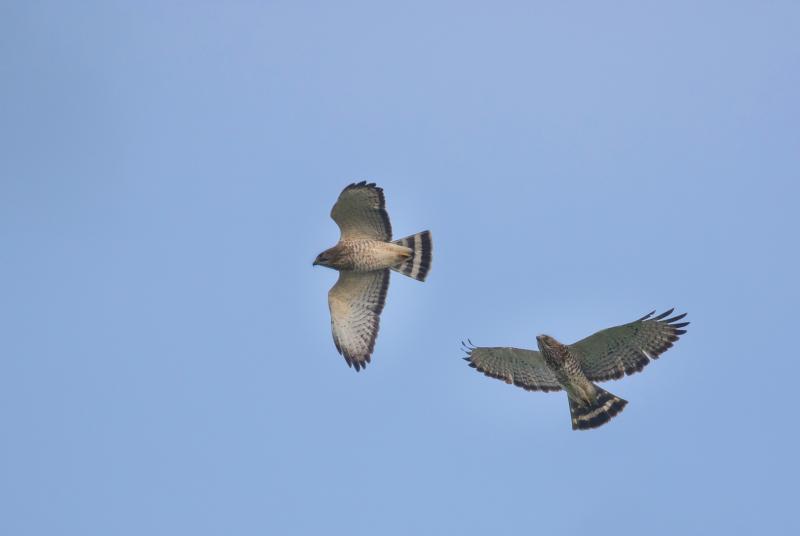 Despite the fact that it's called a "broad-winged hawk," the bird's most striking feature is its black and white striped tail. Photo by Gregory "Slobirdr" Smith, courtesy of Wikimedia Commons CC BY-SA 2.0 <https://creativecommons.org/licenses/by-sa/2.0>
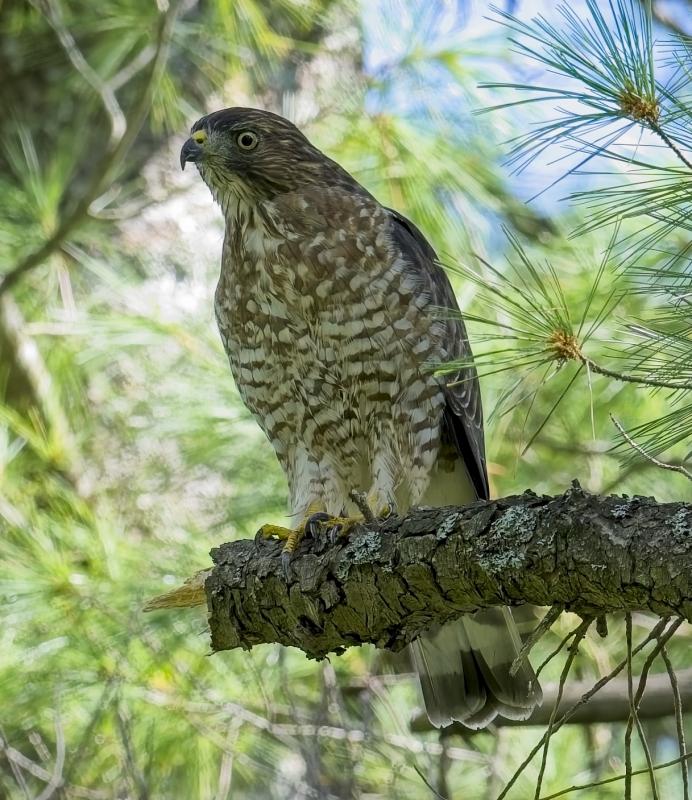 Broad-winged hawks are one of the more frequently seen hawks in summer in the eastern U.S. and southern Canada. Photo by Mykola Swarnyk, courtesy of Wikimedia Commons CC BY-SA 4.0 <https://creativecommons.org/licenses/by-sa/4.0>
Despite the fact that it's called a "broad-winged hawk," the bird's most striking feature is its black and white striped tail. Photo by Gregory "Slobirdr" Smith, courtesy of Wikimedia Commons CC BY-SA 2.0 <https://creativecommons.org/licenses/by-sa/2.0>
Broad-winged hawks are one of the more frequently seen hawks in summer in the eastern U.S. and southern Canada. Photo by Mykola Swarnyk, courtesy of Wikimedia Commons CC BY-SA 4.0 <https://creativecommons.org/licenses/by-sa/4.0>
Broad-winged hawks are one of the more frequently seen hawks in summer in the eastern U.S. and southern Canada. Photo by Mykola Swarnyk, courtesy of Wikimedia Commons CC BY-SA 4.0 <https://creativecommons.org/licenses/by-sa/4.0>
Despite the fact that it's called a "broad-winged hawk," the bird's most striking feature is its black and white striped tail. Photo by Gregory "Slobirdr" Smith, courtesy of Wikimedia Commons CC BY-SA 2.0 <https://creativecommons.org/licenses/by-sa/2.0>
Broad-winged hawks are one of the more frequently seen hawks in summer in the eastern U.S. and southern Canada. Photo by Mykola Swarnyk, courtesy of Wikimedia Commons CC BY-SA 4.0 <https://creativecommons.org/licenses/by-sa/4.0>We hate to be the ones to say this, but could you think of a bird name that’s more boring than this: broad-winged hawk? What does the non-birder imagine when they hear that? Maybe a large, eagle-sized bird with wings as wide as a door? Or do they wonder whether most hawks have narrow wings—this particular “broad-winged” species just really stands out?
The truth is, broad-winged hawks are proportioned like the others in their family, known as buteos. True, their wings are wider than hawks such as falcons and accipiters (sharp-shinned hawks, for example) but they are not noticeably broader than many other hawks or eagles.
The buteo group includes birds like the very familiar red-tailed hawk, the winter visitor rough-legged hawk, and the red-shouldered hawk, the easiest to confuse with the broad-winged hawk. Five other buteo species nest far from Maine in the U.S. and Canada and 18 more different kinds can be found across the world.
Broad-winged hawks are widespread here in Maine, and throughout much of the eastern U.S. and southern Canada. They are, in fact, one of the hawks you’re very likely to see on a roadside utility line or in your backyard in summer, if you have forest nearby or decent tree cover. One of the most characteristic features of the broad-winged hawk is not its broad wings but its rather short and broad tail, which is patterned with chunky black and white stripes. Perhaps we should petition to change the name to the zebra-tailed hawk—that would certainly make its name more memorable and truer to its actual appearance.
In many forested areas, broad-winged hawks catch and eat a lot of snakes, frogs, large insects, and small mammals but also a decent number of small birds, probably especially nestlings or recently fledged young. In our suburban but fairly well-treed neighborhood, we have started to see broad-winged hawks more frequently in summer over the last five or so years. This year, we wondered if there could be two pairs nesting in the vicinity. In the spring, there were, on occasion, four birds circling overhead, giving their whiny, whistled “k-seee” calls. As the summer progressed, we daily heard the alarm calls of starlings, robins, and other birds, often followed by the sight of a broad-winged hawk stealthily gliding between the houses, sometimes with an obvious prey item in its talons.
We’ve wondered if these particular broad-winged hawks may be focusing on bird prey, since our suburban neighborhood is not a great place to find snakes and frogs, although there are a few chipmunks around.
One of the greatest marvels of broad-winged hawks is their migration. We enjoy them here in summer but by late August or early September, most will have begun flying south. Unlike most other hawks, broad-wings like to migrate in large flocks. Sometimes these flocks number in the thousands, providing an unparalleled spectacle of abundance. Single daily counts of migrating broad-winged hawks in south Texas have numbered over 250,000 and in Veracruz, Mexico, over 500,000!
We’ve only got them here in Maine for a few more weeks. Enjoy them while you can!
Jeffrey V. Wells, Ph.D., is a Fellow of the Cornell Lab of Ornithology and Vice President of Boreal Conservation for National Audubon. Dr. Wells is one of the nation's leading bird experts and conservation biologists. He is a coauthor of the seminal “Birds of Maine” book and author of the “Birder’s Conservation Handbook.” His grandfather, the late John Chase, was a columnist for the Boothbay Register for many years. Allison Childs Wells, formerly of the Cornell Lab of Ornithology, is a senior director at the Natural Resources Council of Maine, a nonprofit membership organization working statewide to protect the nature of Maine. Both are widely published natural history writers and are the authors of the popular books, “Maine’s Favorite Birds” (Down East Books) and “Birds of Aruba, Bonaire, and Curaçao: A Site and Field Guide,” (Cornell University Press).