‘The Goldilocks budget’: Committee talks budget work, public comment, more
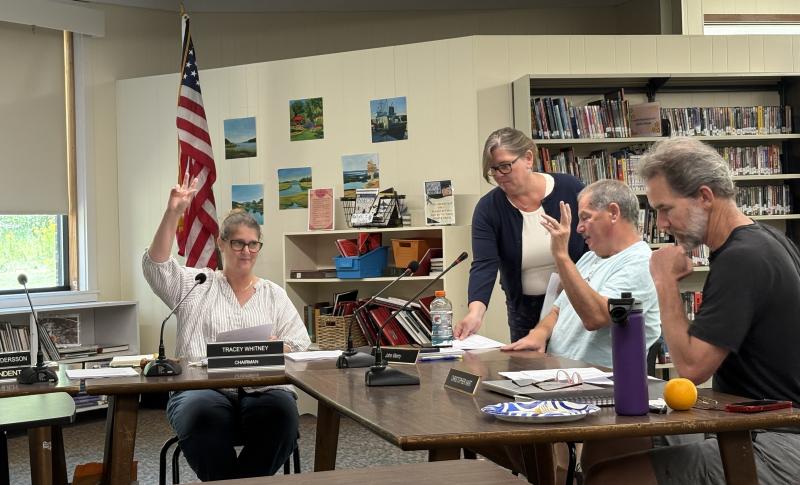 Superintendent of Schools Dr. Kim Andersson Aug. 5 passes out copies of agendas to school committee members, from left, Chair Tracey Whitney, Vice Chair John Merry and member Christopher Hart. Not pictured, member Doug Merrill. Member Jonathan Barnes was not there. SUSAN JOHNS/Wiscasset Newspaper
Superintendent of Schools Dr. Kim Andersson Aug. 5 passes out copies of agendas to school committee members, from left, Chair Tracey Whitney, Vice Chair John Merry and member Christopher Hart. Not pictured, member Doug Merrill. Member Jonathan Barnes was not there. SUSAN JOHNS/Wiscasset Newspaper
Superintendent of Schools Dr. Kim Andersson Aug. 5 passes out copies of agendas to school committee members, from left, Chair Tracey Whitney, Vice Chair John Merry and member Christopher Hart. Not pictured, member Doug Merrill. Member Jonathan Barnes was not there. SUSAN JOHNS/Wiscasset Newspaper What's the best version of budget drafts for Wiscasset's school committee to study? Districtwide totals for items, versus broken down? Both? Which first, and what else?
Members Aug. 5 started mulling this near the close of a morning-long workshop to train them for their service and do some planning. The discussion on future budget work came as Wiscasset, for the second year in a row, nears a town vote on a second school budget offer after the first one lost in June.
Chair Tracey Whitney said, one year, more detail was wanted, and the next year, "clearly I gave everybody way too much, or asked for us to get way too much. We need to figure out what that middle road is for next year's budgeting process. So let's really think about that and revisit that."
"Can we call it the Goldilocks budget," member Christopher Hart said, drawing laughter.
Member Doug Merrill suggested seeing total spending by item, such as telephones, rather than telephones in each part of the budget. "I hate it because telephone's in there 37 times. I just want to know what's our telephone budget, period. That's all I want. I don't care where the money goes" in the different sections, he said. Superintendent of Schools Dr. Kim Andersson explained state statute drives the budget's layout, but she could summarize items as Merrill described.
Members would also, in budget talks, like to tap more of the finance committee's knowledge from its monthly budget reviews. And Vice Chair John Merry said receiving administrators' budget drafts before the administrators present them would "be very beneficial ... It's difficult for those that aren't familiar with the school budget to sit there and listen to somebody and then formulate a question."
Also in the workshop, members eyed trying to, except in emergency items, end meetings by 8 p.m.; adding a monthly workshop or, if needed, a special meeting to finish a regular one that ran long; holding firmer to time limits in meetings' public comment; and trying to avoid same-night proposed additions to agendas. Andersson said even knowing earlier that day would be better than hearing a request for the first time that night.
"I feel so blindsided when people do that," Merrill said.
As for meetings' length, he said, "I frankly get tired of getting home at midnight."
"Oh, yes," Whitney said.
And as for time limits in public comment, Whitney said she will "set a very loud timer ..." In a June committee session, public comment ran almost an hour and a half, Andersson said.
"You lose your viewership," Merry said. Before joining the committee, "I know I've walked off, when it's dragged on," he said.
Since it was a workshop, the committee took no votes.
Members voiced interest in having the student representative to the committee start as early in the school year as possible and having a member mentor them. According to the discussion, the representative is named by school administrators and must be a junior or senior eligible for extracurricular activities; the student does not help make a quorum and any voting the student does is not binding.