XXV Winter Olympics receives a taste of Boothbay in Italian Alps
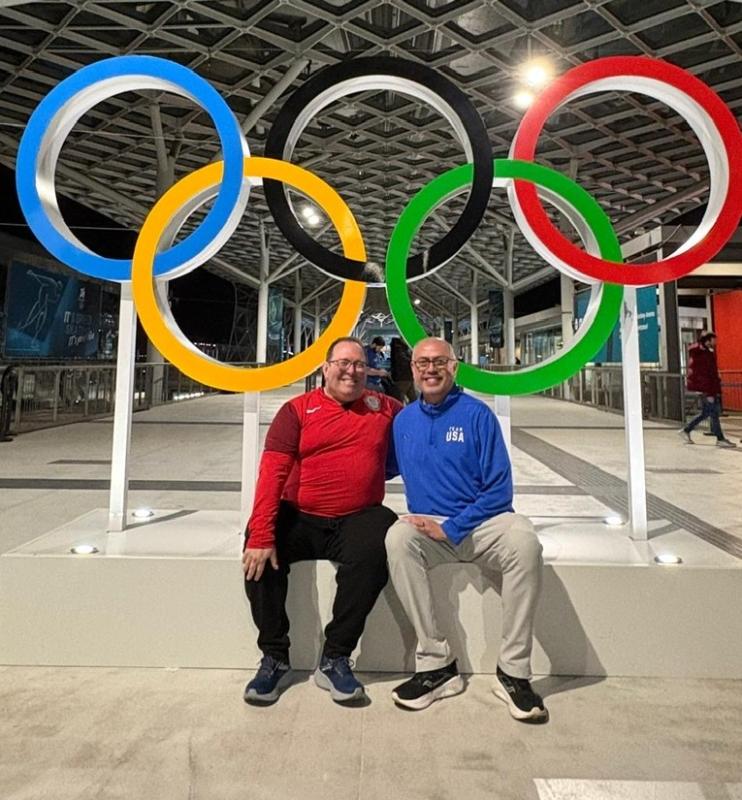 Elliot Schwartz, left, and Bryon Cortez were volunteers at the XXV Winter Olympic games in Italy last month. They are sitting in front of the Olympic rings at Rho Fiera, site of the ice hockey and speed skating events. Courtesy photo
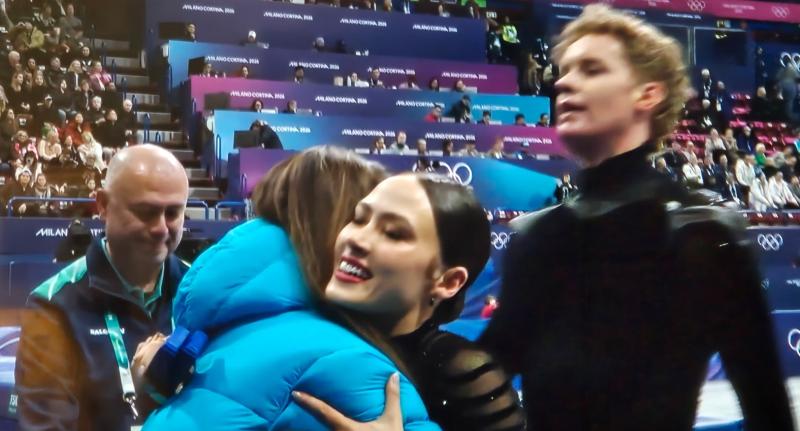 Byron Cortez, far left, worked the figure skating event during the XXV Olympics in Milan last month. Here, he assists ice dancers Madison Chock and Evans Bates off the ice during the Olympic Team Figure Skating competition. Courtesy photo
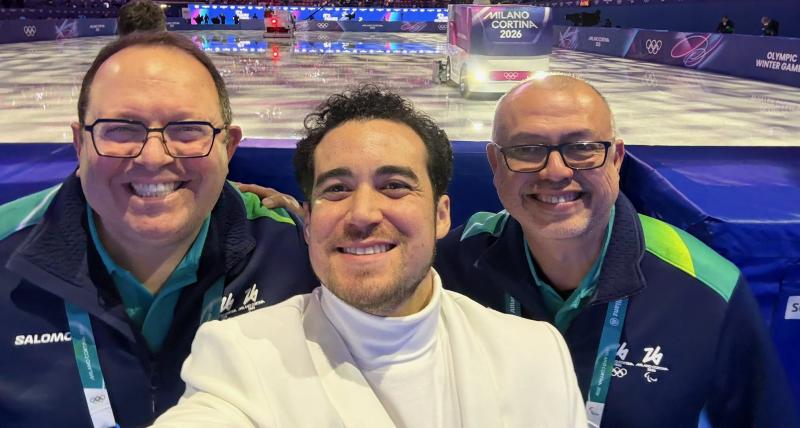 Elliot Schwartz and Byron Cortez pose with Jordan Cowan, middle, the inventor of a special camera designed to catch skaters' reaction after their skate. Courtesy photo
Elliot Schwartz, left, and Bryon Cortez were volunteers at the XXV Winter Olympic games in Italy last month. They are sitting in front of the Olympic rings at Rho Fiera, site of the ice hockey and speed skating events. Courtesy photo
Byron Cortez, far left, worked the figure skating event during the XXV Olympics in Milan last month. Here, he assists ice dancers Madison Chock and Evans Bates off the ice during the Olympic Team Figure Skating competition. Courtesy photo
Elliot Schwartz and Byron Cortez pose with Jordan Cowan, middle, the inventor of a special camera designed to catch skaters' reaction after their skate. Courtesy photo
Elliot Schwartz and Byron Cortez pose with Jordan Cowan, middle, the inventor of a special camera designed to catch skaters' reaction after their skate. Courtesy photo
Elliot Schwartz, left, and Bryon Cortez were volunteers at the XXV Winter Olympic games in Italy last month. They are sitting in front of the Olympic rings at Rho Fiera, site of the ice hockey and speed skating events. Courtesy photo
Byron Cortez, far left, worked the figure skating event during the XXV Olympics in Milan last month. Here, he assists ice dancers Madison Chock and Evans Bates off the ice during the Olympic Team Figure Skating competition. Courtesy photo
Elliot Schwartz and Byron Cortez pose with Jordan Cowan, middle, the inventor of a special camera designed to catch skaters' reaction after their skate. Courtesy photoln 2024, Elliot Schwartz and his husband Byron Cortez were in Paris for the summer Olympics. And last month, the two were in Milan for the 2026 Olympic games. The East Boothbay couple participated in the XXV winter games as International Olympic Committee volunteers.
The couple arrived in Milan a couple days prior to the games which ran from Feb. 6 to Feb. 22. The two worked various figure skating events for four days. Schwartz is a former U.S. Olympic Committee employee. He attended the Paris games as a U.S. Olympic Committee worker. But this time he joined his husband as a volunteer in Milan.
The opportunity allowed Cortez and Schwartz to work the figure skating venue and check out other Olympic events. "It was an amazing experience," Cortez said. "I had a chance to watch the speed skating as a spectator, and watched Jordan Stoltz win his first gold medal," he said. "It was both exciting and emotional. I cried while singing the national anthem. How many times in your life can you see an American win a gold medal, and sing the national anthem."
Cortez and Schwartz were among 18,000 Olympic volunteers in Milan/Cortina and, according to the IOC website, 130,000 volunteer applications were received from 98 countries. The two East Boothbay men had an "inside track" to receiving an appointment. First, Cortez was an experienced Olympic volunteer. Schwartz is an international figure skating official who has contacts within the international landscape.
In a conversation with Daiana Aggiano at the 2025 (April) World Synchronized Figure Skating Championships in Helsinki, the two took a major step in securing an Olympic appointment. Aggiano was working as a skating data replay operator. Aggiano is also an International Olympic Committee contractor who was in charge of hiring volunteers for the Milan games. "She asked us if we wanted to volunteer, and it was like of course we do," Schwartz said.
Aggiano provided them with the application information which meant they only needed to apply, and not interview. And that's how Schwartz and Cortez became two of 240 Olympic figure skating volunteers. Cortez was assigned as a door operator. He was charged with opening and closing the door behind skaters. Cortez said volunteers were given explicit orders about their conduct. "There is no eye contact or talking to the athletes as they enter or exit. Only if they interact with you," he said.
At the figure skating team competition, the two worked two of the four-night team competition which featured performances by men's and women's singles, pairs and ice dancers. Cortez had a bird's eye view of team camaraderie after each American performance. He was situated near Team USA's box, and saw the post-skate reactions from the skaters and their teammates. "Oh, it was amazing. I watched them return to their boxes with a big smile and receive congratulations from their teammates. It was great," Cortez said.
As a volunteer, Schwartz was responsible for assisting the flower girls and boys on and off the ice. He also assisted in making sure the ice was clean following a performance. Another duty was guiding coaches to their proper position during a performance.
Like Cortez, Schwartz followed the protocol of not interacting with athletes, but some performers liked to interact with the volunteers. "One Polish male pair skater always spoke after a performance to us. So, I know a little Polish and said "Chesc' (hello) and I received a response back," he said.
Schwartz also worked on a couple of special assignments for U.S. Figure Skating during the Olympics. He provided analysis for Team USA's gold medal-winning performance. He worked on a predictive model if the team needed Ilia Malinan to skate in the men's long program. "The analysis showed our team needed to be ahead by six points after the short program to win without Ilia skating the long program. It was so close with the Japanese, the analysis showed the other two Americans wouldn't score high enough to achieve the gold medal."
Before the Olympics, Schwartz worked with U.S. Figure Skating in a partnership with Snowflake, Inc. for a marketing campaign featuring videos of American legends Brian Boitano, Gracie Gold, Charlie White and Brandon Frazier. "We used AI (artificial intelligence) videos and interviews to provide insights about Olympic competition," he said. Schwartz said he asked White a question during the video, but couldn't remember what it was.
Post-competition, U.S. Figure Skating asked Schwartz to do an analysis of the judging in the Pairs competition where the French duo Laurence Fournier Beaudry and Guillaume Cizeron edged the American pair of Madison Chock and Evan Bates by 1.43 points to win gold. Schwartz decline to detail what the analysis showed.
The East Boothbay pair also brought the coast of Maine to the Italian Alps. They purchased small gifts for other Olympic volunteers as mementos of coastal Maine. "We were the unofficial 'Maine Ambassadors,'" Cortez said. "We brought some items bought at Sherman's: key chains, bottle openers, books about coastal Maine and stuffed lobsters. Everybody really enjoyed their gifts."
The two returned to East Boothbay Feb. 20, but another trip is planned in the near future. Schwartz is scheduled to work as a judge at the World Synchronized Figure Skating Championships in Salzburg, Austria on April 10 and 11.